
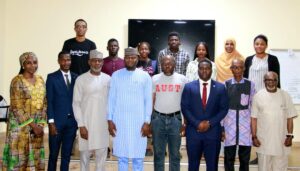
Innovative approaches to affordable construction and environmental waste management took centre stage as Civil Engineering final year students at the African University of Science and Technology (AUST), Abuja, presented their research projects which explored sustainable alternatives to conventional building materials and practical solutions to pressing environmental challenges.
The 2025/2026 final-year project defenses brought together students, academic staff and external assessors for a rigorous evaluation of research addressing Nigeria’s housing challenges, construction costs and waste management concerns.
Opening the session, the Head of the Department of Civil Engineering, Dr Olusegun Toluhi, welcomed attendees and encouraged the students to approach their presentations with confidence.
He described the defense as the culmination of years of academic commitment and perseverance, before outlining the programme and allocating ten minutes to each candidate for their presentation, followed by questions and evaluation by the external examiner.
The first presentation featured finalist Dikeocha Solomon, whose research examined the stabilisation of lateritic soil in Abuja using palm-bunch ash and Arabic gum as potential sustainable alternatives to cement in construction.
The study highlighted Nigeria’s significant housing deficit and the rising cost and environmental impact of conventional cement-based construction. Through laboratory testing of different material combinations, the research identified a mixture containing 10 per cent palm-bunch ash and 4 per cent Arabic gum as the most effective among those evaluated, improving the engineering properties of the soil while reducing water absorption.
During the assessment, the external examiner, Engr Prof Abdulhameed Mambo, commended the student’s composure, presentation materials and detailed laboratory documentation. However, he raised technical concerns about the reported unconfined compressive strength (UCS) values, which appeared unusually high.
Professor Mambo advised the student to review the calculations, particularly the relationship between the crushing load and the specimen’s cross-sectional area, and to verify the testing machine’s calibration and the relevant baseline values. He stressed the importance of ensuring that reported results were technically sound and consistent with accepted engineering principles.
The second presentation, delivered by finalist Kolawale Bankole, explored the use of air-dried, cold-processed sewage sludge as a partial replacement for quarry sand in concrete intended for light-duty rigid pavements.
Addressing the environmental implications of sewage sludge disposal, the research investigated replacement levels of 0, 10, 20 and 30 per cent to determine their effects on the concrete’s performance. The findings identified a 10 per cent replacement level as the most promising balance among the mixtures tested, based on the reported workability, density and durability characteristics.
Professor Mambo commended the project for exploring a potentially low-energy approach to waste utilisation. However, he highlighted methodological shortcomings, particularly the limited number of specimens tested at each curing age, noting the importance of adequate sampling to support reliable and reproducible findings.
He also emphasised the need to address the biological and chemical hazards associated with sewage sludge, including potential exposure to pathogens and heavy metals. He urged the student to give greater attention to material-handling precautions, environmental safety and the implications of incorporating treated sludge into construction materials.
Concluding the day’s proceedings, the President of AUST, Professor Azikiwe Peter Onwualu, FAS, commended the depth of the technical discussions and expressed appreciation to the external examiner for the thorough assessment of the students’ work.
Professor Onwualu also challenged academic supervisors to strengthen the research output of the University by ensuring that final-year projects are developed with the potential to generate at least one peer-reviewed publication and one formal patent.
The project defences underscored the importance of combining innovation with rigorous scientific evaluation, demonstrating how student research can contribute to sustainable construction, resource efficiency and solutions to Nigeria’s developmental challenges. They also reinforced the need for sound research methods, technical accuracy and safety considerations in translating academic findings into practical applications.