The African University of Science and Technology (AUST) is positioning itself for a major academic expansion following a comprehensive resource-verification exercise by the National Universities Commission (NUC).
Established in 2007 as a strictly postgraduate institution, AUST has continuously evolved to offer both postgraduate and undergraduate education while maintaining its core emphasis on high-level research.
The evaluation focused strictly on assessing the institution’s physical facilities and academic staffing readiness to launch 11 proposed undergraduate programmes as a foundational resource review rather than a formal accreditation visit.
The 11 proposed disciplines span cutting-edge fields in technology, design, and social sciences, including: Artificial Intelligence; Data Science; Cybersecurity; Information Systems; Architecture; Economics; Banking and Finance; Nursing; Medical Laboratory Technology; Industrial Chemistry; Computer Engineering.
Addressing the NUC resource-verification team, AUST President, Prof. Azikiwe Peter Onwualu, FAS, noted that while infrastructure remains strong, recruiting sufficient resident academic staff stands as the institution’s primary constraint.
To bridge this gap, AUST utilizes a hybrid delivery model, combining traditional semester-based undergraduate education with modular postgraduate formats supported by visiting foreign lecturers while local faculty capacity is actively developed.
He also highlighted that the institution continues to leverage its AUSTInspire incubation Hub to drive innovation and industry linkages, alongside strategic partnerships that support engineering, space technology, research, and innovation.
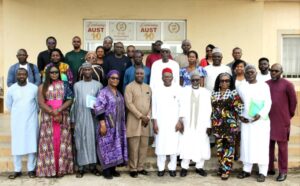
Leading the NUC resource-verification team, Dr. Esther Imuetinyan Mmeka, Director of the Directorate of Skills Development and Entrepreneurship (DSDE) at the National Universities Commission (NUC), commended the University management for its visionary approach in ensuring that AUST is expanding its horizon especially towards undergraduate programmes. She expressed optimism that the exercise would yield positive outcomes. In her words, ”we hope for positivity when we are going to convey the results.”
During the visit, the NUC team was tasked with verifying physical facilities and confirming the physical availability of academic staff on campus. Detailed programme-by-programme assessments were delegated to specialized review groups.
The final assessment outcome and official approval from the NUC remain pending.
The NUC verification team included: Architecture (BSc) – Panel: Prof. Ibrahim Abubakar Alkali (Bayero University, Kano), Dr. Esther Mmeka, Mrs. Maureen Austine; Nursing Science (BSc) – Panel: Prof. Abdurrahman Sani Mohammed (Usmanu Danfodiyo Univ., Sokoto), Mr Agbo unji Olusegun Daniel and Mrs Adewuola Oguntimehin; Medical Laboratory Technology (BSc) – Panel: Prof. Nkiru Azubike (Univ. of Nigeria, Nsukka), Mr. Livinus Odum, Mr. Bashir; Banking and Finance (BSc) – Panel: Prof. Muhammad Madawaki (Univ. of Maiduguri), Mr. Ehibor Moses (NUC); Economics (BSc) – Panel: Prof. Lionel Effiom (Univ. of Calabar), Mrs Ojei Ekene Praise (NUC) and Dr Ajani; Industrial Chemistry (BSc) – Panel: Prof Oforghor FranklineDinero, Mrs. Vera Anthony, Mr. Uche (NUC); Cybersecurity (BSc) – Panel: Prof. Saleh (Sale) Abdullahi (Nile University, Abuja), Mrs. Stella Chigbo (NUC); Artificial Intelligence (BSc) – Panel: Prof. Saleh Abdullahi (Nile University), Mrs. Stella Chigbo (NUC); Data Science (BSc) – Panel: Prof. Saleh Abdullahi (Nile University), Mrs. Stella Chigbo (NUC); Information Systems (BSc) – Panel: Prof. Saleh Abdullahi (Nile University), Mrs. Stella Chigbo (NUC); Computer Engineering (BSc) – Panel: Prof. Christopher Ngene (Univ. of Maiduguri), Ms. Kate (NUC).