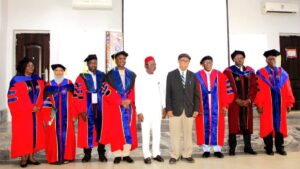
The African University of Science and Technology (AUST) formally inducted its pioneer cohort of Senior Research Fellows into the Centre for Peace and African Studies (CePAPS) on Monday, October 26, 2026, alongside the official launch of a continent-wide research initiative aimed at reshaping African governance.
The ceremony, held at the university’s campus in Abuja, brought together accomplished diplomats, policymakers, academics, and industry leaders tasked with bridging the gap between academic research and practical societal impact across Africa.
Addressing the gathering, AUST President Professor Peter Azikiwe Onwualu, FAS noted that the induction marks the first time the university has admitted senior research fellows into any of its nearly ten specialized centers of excellence. He emphasized that while pure academic publication remains valuable, AUST’s centers are designed to drive tangible solutions to continental challenges, particularly conflict resolution, peacebuilding, and industrial development.
“CePAPS has come up with this idea of having very senior research fellows that will drive research, mentor younger researchers, and ensure that we are able to do what we have in mind; which is developing solutions to solve Africa’s problems,” Prof. Onwualu said.
CePAPS Director Professor Chudi Uwazurike welcomed the inductees, describing the three-year-old center as a hub for “proven talents” committed to Pan-Africanism in both name and profession.
The pioneer cohort of Senior Research Fellows inducted at the ceremony includes: H.E. Amb. Jean Robert Pillard, Ambassador, Republic of Haiti to South Africa; Dr. Dakuku Peterside, Former Director-General of the Nigerian Maritime Administration and Safety Agency (NIMASA) and public policy reformist; Ambassador Gregory Okon, Seasoned Nigerian diplomat and former Ambassador Extraordinary and Plenipotentiary to Equatorial Guinea; Professor Abdulhakeem Bello, Vice President (Academics) and Director of Academic Planning at AUST, and a renowned physicist specializing in sustainable energy; Dr. Maryam Maruf Yakubu – Director of the National Assembly Budget and Research Office (NABRO); Dr. Jerry Uchenna Nwohu, Security and strategic governance expert and Special Advisor to the Deputy Speaker of the House of Representatives; Dr. Eunice Ngozi Akpala-Okoroafor, Acting Director of the Research and Innovation Directorate at AUST; Dr. Vitalis Anye, Dean of the School of Engineering at AUST and winner of the 2026 Nigerian Academy of Engineering Innovation competition.
A major highlight of the event was the unveiling of the African Leadership Legacy Project (AfriLead), anchored by newly inducted fellow Dr. Dakuku Peterside.
Set to run over the next 18 months, the flagship research and documentation initiative will examine how public and private sector leaders build enduring institutions and transmit ethical values beyond their time in office. Supported by a network of 10 researchers across Africa and the UK, the project will study 500 leaders across five primary countries: Nigeria, Rwanda, South Africa, Egypt, Ghana, and Kenya.
“Most African leaders are not legacy-minded; they care about the now, and so they are transaction-minded,” Dr. Peterside stated during his presentation. “If you stay and reflect on how you will be remembered 20 years after you leave office, you will make different choices.” AfriLead will produce an annual African Leadership Legacy Index to measure leaders’ post-tenure impact and establish a fellowship network to train emerging leaders aged 18 to 30.
During a high-level panel session themed “Advancing African Development Through Leadership, Research, and Policy,” the fellows outlined concrete commitments for the next 12 months:
Dr. Eunice Okafor and Prof. Abdulhakeem Bello stressed the need to involve policymakers, legislators, and industry stakeholders from the inception of research projects so findings do not end up “sitting on the shelf.”
Ambassador Gregory Okon proposed establishing a bold “Action Committee” to mobilize indigenous funding from African governments and private-sector leaders rather than relying on foreign donors whose agendas may not align with local priorities. Dr. Vitalis Anye pointed to Nigeria’s pending 30% Value Addition Bill and the AUST Inspire Business Incubation Center as vital steps toward converting African raw materials and university research into local enterprises and jobs. Dr. Jerry Nwohu and Dr. Maryam Yakubu called for stronger early-warning conflict mechanisms, peer-review systems, and cross-sector task forces to ensure legislative bills and national budgets are guided by empirical data.
The event concluded with the formal robing of the inductees by the AUST President and the Director of CePAPS, followed by an executive strategy luncheon at Mandela Hall.