
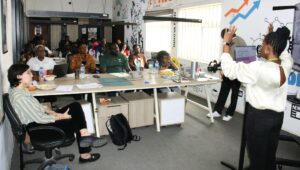
The Center for Planning and Design Innovation (CPDI) Africa, in collaboration with the African University of Science & Technology (AUST), hosted the Industrialised Construction for Sustainable Development (IC4D) Workshop and Hackathon at the Center for Afrocentric Design Advancement (CADA) in Abuja. Held over four days from the 24th to the 27th of September, the event brought together architecture, engineering, and construction professionals to explore how modular and prefabricated building techniques can deliver affordable, high-quality, and culturally responsive housing across Nigeria and the wider African continent.
Opening remarks were delivered by Ms. Nmadili Okwumabua, Director of the CPDI Africa Center for Afrocentric Design Advancement (CADA) at AUST who welcomed the participants and encouraged them to be a part of the research in improving our housing conditions. The research-driven programme was led by Ms. Simi Aluko, a Stanford University PhD candidate in Civil & Environmental Engineering whose research focuses on industrialised construction in developing contexts. Ms. Aluko guided participants through foundational learning, pricing, assembly processes, and hands-on prototyping.
Centered around the theme of “The Everyday Home,” the hackathon challenged participants to design a repeatable building system capable of housing occupants quickly, efficiently, and cost-effectively using Industrialized Construction (IC) principles. Rather than designing a single structure, teams developed scalable platforms and were required to produce four key deliverables:
Product Model: A visual prototype showcasing exterior appearance, finishes, and layout for a unit measuring at least 35 square meters; Product Platform: A detailed parts list specifying part quantities, dimensions, and required tolerances for builders; Process Platform: A comprehensive breakdown of manpower, skills, tools, equipment, and materials needed for execution; Process Model: A field-level installation manual designed for local contractors to assemble components.
A central feature of the workshop was the direct collaboration between design professionals and local artisans. Teams worked alongside assigned artisans to prefabricate wall components ahead of the final showcase.
The event concluded on Demo Day with a timed segment where each team paired with a new artisan to assemble a 1.2x2m wall section using their prefabricated elements live in front of a viewing audience. The process highlighted the critical bridge between architectural drawings and field execution, emphasizing the role of skilled labor and local materials in successful construction. At the conclusion of the event, Team Arrowhead, representing Arrowhead International Integrated Services Limited emerged as the official winners of the competition. Participants commended the organizers and leadership for demonstrating how localized industrialised construction can build local capacity and respond directly to Africa’s cultural, environmental, and housing realities.