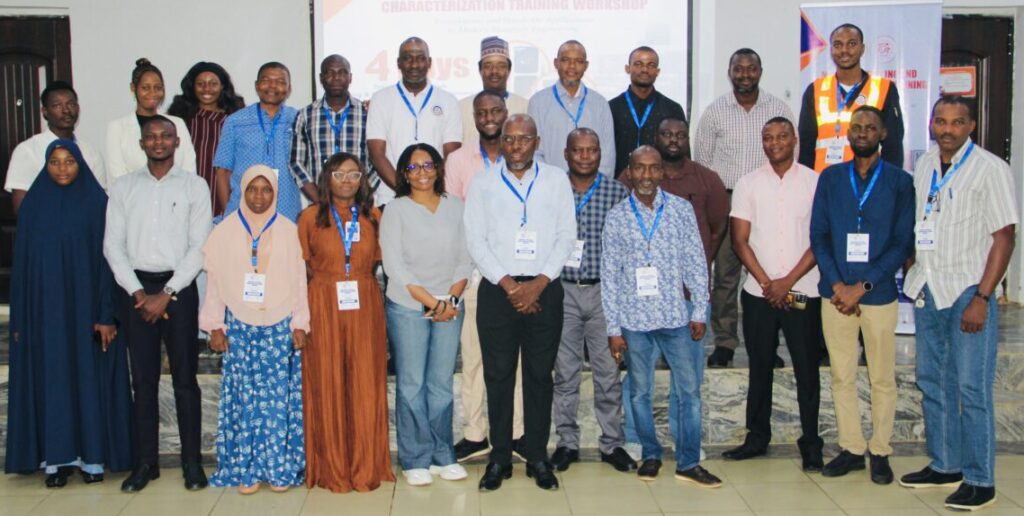
The African University of Science and Technology (AUST), Abuja, has successfully concluded a four-day intensive training programme on Materials Testing and Characterization Fundamentals, aimed at equipping participants with practical and theoretical knowledge of modern materials science and engineering.
The training commenced with a welcome address by the Dean of Engineering, Dr. Vitalis Anye, who received the participants and provided an overview of the university’s vision, academic excellence, and commitment to research-driven innovation. He also introduced Dr. Abdulhakeem Bello, DAP/Acting Vice President, Academic, as one of the facilitators for the training.
In his opening remarks, Dr. Anye emphasized that materials are fundamental to human existence and technological advancement. He traced the evolution of human civilization through the development and use of materials, highlighting the Stone Age (2.5 million BC), Bronze Age (3500 BC), Iron Age (1000 BC), Nuclear/Silicon Age (20th Century), and the ICT/Nanotechnology Age (21st Century).
He further explained the relationship between Materials Science and Materials Engineering, describing them as two sides of the same coin with a focus on discovery, design, and application. Participants were introduced to the periodic table as a guide to understanding material behaviour and explored the major classes of engineering materials, including metals, polymers, ceramics, and composites, with special attention given to carbon fibre reinforced polymers and industrial alloy applications.
A key component of the training focused on laboratory safety standards and best practices. Participants were taken through essential safety procedures, engineering controls, electrical and chemical hazard management, housekeeping practices, fire safety, and the responsibilities of laboratory users in maintaining a safe working environment.
The programme also covered the fundamentals of mechanical testing, including the concepts of reversible and permanent deformation, atomic displacement, plastic deformation, and micro-hardness diagnostics. Facilitators demonstrated how force and depth measurements are continuously recorded during testing to determine the elastic and plastic behaviour of materials.
The second day had Mr. Cyril Onyekachi Okoye, Manager, AUST-AfDB laboratory,
delivered sessions on core mechanical testing methods and the physical interpretation of the stress-strain curve. He also discussed essential testing hardware, pre-test procedures, dimensional inspection, system setup, and post-fracture analysis, stressing the importance of never bypassing safety enclosures during high-capacity structural testing.
Participants also had practical, hands-on exposure to some of the advanced equipment available in the laboratory, enabling them to connect theoretical concepts with real-world applications.
The third and fourth days featured lectures by Dr. Odette Ngasoh, a faculty member, who introduced participants to the principles and applications of electrochemical analysis, further broadening their understanding of material characterization techniques.
At the close of the training, participants expressed appreciation to AUST for organizing the programme and recommended that future editions be extended beyond four days to allow for more in-depth practical sessions.
Delivering the closing remarks on behalf of the President of AUST, who was unavoidably absent due to official engagements,Dr. Abdulhakeem Bello DAP/Acting Vice President appreciated the participants for their commitment and encouraged them to apply the knowledge gained in advancing engineering practice and research.
Certificates of participation were subsequently presented to all attendees.The successful training underscores AUST’s dedication to developing skilled professionals and promoting excellence in engineering education, research, and innovation.