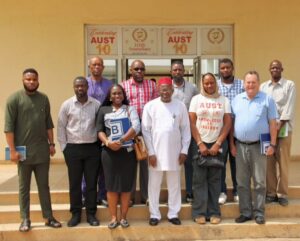
The African University of Science and Technology has commenced discussions with Julius Berger Nigeria Plc on a strategic partnership aimed at strengthening technical and vocational skills development, workforce upskilling, and industry-focused training programmes.
The engagement, held at the university in Abuja, brought together senior management staff of AUST and representatives of the Julius Berger Skills Academy to explore areas of collaboration in technical education, curriculum development, and practical industry training.
Welcoming the delegation, the President of AUST, Prof. Azikiwe Peter Onwualu, FAS, described Julius Berger as one of Nigeria’s foremost engineering and infrastructure companies and commended the organisation’s longstanding reputation for quality and technical excellence.
Prof. Onwualu noted that AUST, originally established in 2007 as a postgraduate institution under the Nelson Mandela Institution framework, has expanded into undergraduate engineering and information technology programmes with a strong emphasis on practical skills acquisition and innovation-driven education.
According to him, the university established the AUST Inspired Innovation Hub and several technical workshops to bridge the gap between academic learning and industry requirements.
“We identified a major gap in Nigeria’s educational system in the area of practical skills. As a result, our programmes are now more skill-oriented, especially in engineering and technical education,” he said.
He explained that the university currently runs Technical and Vocational Education and Training (TVET) programmes in areas such as mechatronics, welding, plumbing, fabrication, cybersecurity, networking, and other professional short courses.
Speaking on behalf of Julius Berger, vocational education adviser to the Julius Berger Skills Academy, Bjoin Braubach, said the company was reforming its Plant and Equipment Department (PED) Academy to align with global best practices and emerging industry demands.
Braubach explained that the academy oversees the maintenance, operation, transportation, and lifecycle management of the company’s heavy equipment and machinery, adding that the organisation was seeking academic and technical partners capable of supporting structured workforce development.
He said the company required support in assessing the proficiency levels of technical personnel, co-developing competency-based curricula, and delivering practical and theoretical training programmes tailored to industry realities.
“Our best technicians are gradually approaching retirement, while younger technicians still require significant upskilling. We need a system that allows us to transfer knowledge effectively and build the next generation of technical leaders,” he stated.
Also speaking, Goodness Orsta emphasised that the proposed arrangement should go beyond financial considerations and evolve into a mutually beneficial partnership.
She said such collaboration could include internship placements for AUST students, practical training exchanges, curriculum support, and shared technical expertise.
The discussions also highlighted the growing mismatch between university training and industry expectations, particularly in engineering and technical operations.
Prof. Onwualu stressed the need for stronger collaboration between academia and industry to ensure graduates possess not only academic qualifications but also practical competencies relevant to the workplace.
He referenced the university’s existing industry advisory initiatives and partnerships with organisations such as the Nigerian Space Agency, Raw Materials Research and Development Council, Cisco Academy, and other international development partners.
The meeting further explored possible models for integrating classroom instruction with hands-on industrial training, including the use of company workshops, university laboratories, and external technical experts.
Both parties agreed to continue engagements through follow-up technical meetings and facility assessments aimed at developing a detailed framework for collaboration.
Present at the meeting from the African University of Science and Technology were Prof. Azikiwe Peter Onwualu, President of AUST; Dr. Abdulhakeem Bello, Director of Academic Planning and Acting Vice President; Dr. Prisca Onuoha, Coordinator of Continuing Professional Development (CPD); Engr. Dr. Mikel Amonye, Head of Engineering Workshop; Dr. Vitalis Anye, Dean of the School of Engineering; Mr. Atulomah Obioha, Head of Media Services and Public Relations Unit; Mr. Daniel Israel, Instructor in Mechatronics Engineering; Mr. Raphael Amonye; Ugokwe Chinedu, CPD Administrative Assistant; and Blessing Iweha, Media Administrative Assistant .
From Julius Berger Nigeria Plc were Bjoin Braubach, Vocational Education Adviser at the Julius Berger Skills Academy, and Goodness Orsta of the Human Resources Department.