The African University of Science and Technology (AUST), the Science, Technology and Innovation Department of the Federal Capital Territory Administration (STI-FCT), and development partners have reaffirmed their commitment to advancing research, innovation, skills development, and technology-driven socio-economic growth through a strategic collaboration.
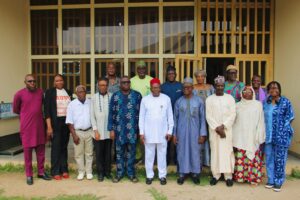
The partnership discussions took place during a high-level meeting in Abuja led by the AUST President, Professor Azikiwe Peter Onwualu, FAS, alongside the Director of STI-FCT, Dr. Olobashola Kolawole, and partner representative, Engr. Lucky Nwaosa.
The meeting focused on reviewing the Memorandum of Understanding (MoU) between the institutions and outlining practical areas of cooperation aimed at strengthening science, technology, engineering and mathematics (STEM) education, research commercialisation, and industrial development.
Speaking during the engagement, Professor Onwualu described AUST as a pan-African research university committed to providing world-class STEM education and practical research solutions that support policy development, innovation, and national transformation.
Professor Onwualu highlighted AUST’s innovation hub and consultancy-driven model, which seeks to transform academic knowledge into practical enterprise, funded research, start-up development, and industry-ready skills for graduates. He also discussed successful grant-supported initiatives, staff training opportunities, and ongoing collaborative projects designed to improve technical expertise and institutional research capacity.
Prof. Onwualu further announced scholarship opportunities for qualified residents of neighbouring host communities, as well as educational support initiatives for staff participating under the collaboration framework.
As part of the collaboration, stakeholders proposed professional short courses in areas such as grant proposal development, research mobilisation, revenue generation, and research writing for government agencies, SMEs, academic staff, and external participants.
The agreement identified four major objectives of the collaboration, including promoting the adoption of emerging technologies, building capacity in digital and disruptive technologies for civil servants and students, supporting STI-FCT in research and policy development, and creating platforms that encourage innovation and socio-economic advancement.
The MoU also outlined the responsibilities of the parties, covering programme supervision, curriculum approval, faculty engagement, certification processes, venue provision, publicity, and joint planning of training initiatives. Revenue generated from approved programmes will be shared among the collaborating institutions based on agreed terms.
Prof. Onwualu further explained that the implementation of projects and programmes under the agreement would require mutual written approval, while designated representatives from each institution would coordinate activities and monitor progress. The partnership framework also allows financial and material contributions from participating organisations where necessary.
During the discussions, Dr Kolawole emphasised the importance of accelerating science and technology initiatives across the FCT through practical partnerships capable of producing measurable developmental impact.
Dr Kolawole also reflected on previous industrial and research-based projects, including the development of rock-cutting and polishing machines, recycling technologies, and raw-material processing equipment funded through collaborative government and institutional support. He highlighted the establishment of fabrication showrooms and partnerships with engineers and technical experts as evidence of Nigeria’s growing innovation capacity.
A major focus of the engagement was the need to strengthen research development among technical and educational personnel. He called for increased support in grant writing, research training, innovation management, and practical scientific development for staff and young professionals.
Dr Kolawole also examined opportunities linked to the proposed National Research and Innovation Fund, which is expected to prioritise innovation commercialisation, entrepreneurship, industrial application, and problem-solving research capable of attracting local and international donor support.
The meeting underscored the importance of reviving technical and vocational education pathways while strengthening the relationship between engineers, technologists, technicians, researchers, and industry practitioners.
He also described the partnership as a strategic platform for building sustainable national capacity in science, technology, innovation, and entrepreneurship through research-driven collaboration and institutional cooperation.
The meeting concluded with renewed commitments to deepen collaboration, support upcoming initiatives such as Africa Science Week, and continue discussions on pilot plants, SME development projects, agro-waste conversion initiatives, and small-scale industrialisation opportunities. Stakeholders also encouraged experienced professionals and retired practitioners to contribute to teaching and mentorship programmes aimed at bridging the gap between academia and industry.