
The President of the African University of Science and Technology (AUST), Abuja, Prof. Azikiwe Peter Onwualu, has reaffirmed the institution’s commitment to strengthening partnerships that promote technological innovation, agricultural development and local manufacturing in Nigeria.
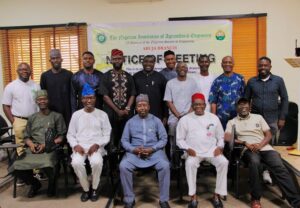
Prof. Onwualu stated this while welcoming members of the Nigerian Institution of Agricultural Engineers (NIAE), Abuja Chapter, to the university during the Chapter’s quarterly meeting hosted at AUST.
The AUST President emphasised the importance of collaboration between academia, industry and professional bodies in addressing Nigeria’s technological and agricultural challenges. According to him, homegrown technologies remain critical to solving problems related to food security, energy, transportation and industrial development.
He noted that AUST was actively promoting innovative solutions in areas such as irrigation, renewable energy, climate-smart agriculture, vertical farming, hydroponics and artificial intelligence-driven systems. He also highlighted ongoing university projects focused on converting agricultural waste into biofuels and biogas through biodigester technology.
Prof. Onwualu further disclosed that the university had already signed a Memorandum of Understanding (MoU) with the Nigerian Institution of Agricultural Engineers and stressed the need to operationalise the agreement to achieve meaningful impact in agricultural engineering and technology development.
Speaking earlier, the Chairman of the NIAE Abuja Chapter, Engr. Mauruf Ajenifuja, described the meeting as a defining moment for Nigeria’s agro-industrial future. He stressed the need for the country to reduce dependence on imported machinery spare parts, noting that many agricultural machines become obsolete due to the high cost and unavailability of replacement components.
According to him, the meeting represented the beginning of a new blueprint for agro-industrial sovereignty through local manufacturing, engineering innovation and sustainable industrial development.
The meeting featured a technical presentation titled “Low-Cost Technologies for Setting Up Production of High-Quality Industrial Parts,” delivered by the NIAE Public Relations Officer, Dr. Benjamin Attah.
In his presentation, Dr. Attah outlined practical manufacturing techniques capable of supporting local production and reducing Nigeria’s dependence on imported industrial components. He explained various manufacturing processes including sand casting, welding, machining, shearing and forming.
He stated that locally available materials such as bentonite and foundry sand could be effectively utilised in the production of industrial components including engine blocks, pump housings, pulleys and crusher hammers.
Dr. Attah also highlighted the role of welding technologies in the fabrication of agricultural and industrial equipment, citing locally fabricated crushers, dryers and tractor canopies as examples of successful innovation using available resources.
Speaking on machining processes, he stressed the importance of precision engineering, quality control and modern technologies such as Electrical Discharge Machining (EDM) in achieving international production standards.
He further called for improved investment policies, affordable electricity supply and stronger collaboration among government, industry and academia through the triple-helix model to revitalise Nigeria’s manufacturing sector.
Dr. Attah also encouraged young engineers and graduates to explore opportunities in small-scale manufacturing and fabrication, describing local production as essential to sustainable national development.
During the interactive session, participants raised concerns about maintaining international standards for locally produced industrial parts. Responding, Dr. Attah acknowledged the challenge but described it as an opportunity for Nigeria to strengthen its manufacturing systems through research, innovation and improved regulatory frameworks.
Earlier in the meeting, the Secretary of the Chapter, Engr. Mathias Savaerun, welcomed participants and commended members for their continued commitment to the activities of the association.
The meeting concluded with renewed calls for stronger institutional collaboration, investment in local manufacturing capacity and the adoption of practical engineering solutions to support Nigeria’s agricultural transformation and industrial growth.