The African University of Science and Technology (AUST), Abuja, has reaffirmed its commitment to advancing research excellence, innovation, and gender inclusion following a high-level stakeholder engagement to review institutional progress and future priorities.
In his welcome remarks, the President of AUST, Professor Azikiwe Peter Onwualu, FAS, received the delegation from the African Development Bank (AfDB) and expressed appreciation for the Bank’s continued support. He provided an overview of the University’s growth, noting that AfDB’s interventions have significantly contributed to the development of AUST, particularly in strengthening its laboratory infrastructure, which he described as among the best in the region.
He emphasised the University’s sustained efforts to raise both academic and practical research standards, highlighting that AUST graduates are increasingly publication-ready and highly employable due to their strong research background and industry-aligned training. He concluded by acknowledging AfDB as a critical partner and expressed optimism for continued collaboration.
Also speaking, Dr Vitalis Anye, Dean of the School of Engineering and Head of the Department of Materials Science and Engineering, showcased AUST’s investments in laboratory infrastructure and strategic partnerships. He noted the University’s responsiveness during critical periods such as the COVID-19 lockdown, when its facilities were utilised to produce essential items, including face-shield brackets and protective masks using 3D printing technology.
Dr Anye further outlined priorities for the next phase of development, including the recruitment of world-class faculty, with a strong emphasis on increasing female representation across departments. He also highlighted plans to expand scholarship opportunities at undergraduate, MSc, and PhD levels to attract talented students from across the region, alongside strengthening research funding and start-up support systems.
He further stated that central to the University’s innovation drive is AIC Inspire, identified as a growing hub for entrepreneurship, commercialisation training, and industry collaboration. Participants underscored the importance of embedding short-term industry internships into academic programmes prior to thesis development to ensure that research addresses real-world challenges.
He concluded by addressing infrastructure and sustainability challenges, particularly the need to strengthen maintenance capacity for laboratory equipment. A proposal to power laboratories and key campus facilities using solar energy—estimated at approximately $12 million—was also presented as part of efforts to position AUST as a leading regional STEM hub.
An AfDB beneficiary, Dr Stella Nwachukwu Gozie, who completed her PhD at AUST, presented on the application of nanotechnology in health, agriculture, and food systems. She highlighted innovations including targeted drug delivery for breast cancer treatment, antimicrobial food packaging, wound-healing hydrogels, and climate-resilient agricultural solutions, demonstrating the University’s growing impact in applied research and technology transfer.
Further discussions led by Dr Odette Ngasoh, faculty member and Chairperson of the Gender Committee, focused on gender inclusion outcomes. She reported increased female participation in both student enrolment and staffing, driven by targeted scholarships, mentorship programmes, and the visibility of female role models. Outreach initiatives such as the “Yes, You Can” programme have also inspired young girls to pursue STEM careers through school visits and hands-on demonstrations, including 3D printing.
Ms Lizzy Asomugha, Head of the Centre for Gender and Technology, highlighted key institutional reforms, including the establishment of a gender equality policy, a gender committee, and the Centre of Excellence for Gender, Technology, and Sustainability Development, launched in October 2025. She noted that the Centre is dedicated to generating evidence-based solutions aimed at empowering women and girls across Africa.
Despite these achievements, Dr Odette Ngasoh acknowledged persistent challenges affecting female participation, including childcare constraints, cultural expectations, early marriage, and workplace practices. She called for targeted interventions such as expanded scholarships, dedicated accommodation, and the provision of crèche facilities to better support female students and researchers.
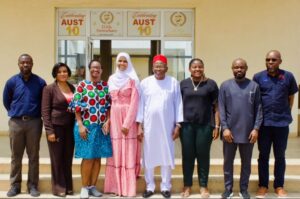
Speaking on behalf of the AfDB delegation, Ms Hay Etther Nwaka (AfDB/IDEV) expressed appreciation for the warm reception and noted that it was her first visit to Nigeria and Abuja. She commended the University’s progress, particularly in gender inclusion, and raised questions on how women are fully integrated into project implementation, as well as how AUST benchmarks its efforts against other institutions. She encouraged closer collaboration with the AfDB team, noting opportunities for shared learning and joint initiatives. She also conveyed appreciation on behalf of her colleagues, Mr Kovame Fofie Hermann and Ms Jacqrehie Nyayahima.
The meeting concluded with a collective agreement to strengthen data-driven reporting, including the provision of disaggregated statistics on gender participation and implementation outcomes. Also committed to continued engagement with development partners through follow-up discussions, work plan sharing, and structured feedback mechanisms.
The engagement underscores AUST’s strategic direction towards building an inclusive, innovation-driven academic environment that not only advances knowledge but also delivers tangible societal impact.
In attendance were Mrs Gloria Ajaegbu, Head of University Advancement and Multilateral Projects Office; Dr Abdulhakeem Bello, Deputy Vice President (Academic); Dr Vitalis Anye, Dean, School of Engineering and Head of Department, Materials Science and Engineering; Mr Ben Okonkwo, Bursar; Dr Assia Aboubaker Mahamal, Faculty; Ms Lizzy Asomugha, Head of General Studies and Head, Centre for Gender and Technology; and Ms Blessing Iweha, Administrative Assistant, Media and Public Relations Unit. Members of the AfDB delegation included Ms Hay Etther Nwaka (AfDB/IDEV), Mr Kovame Fofie Hermann (AfDB/IDEV), and Ms Jacqrehie Nyayahima (AfDB).