STICOMMS 2026 Ends As Stakeholders Call for Effective And Coordinated Science Communication for National Development
Abuja, Nigeria – January 22, 2026
The African University of Science and Technology (AUST), Abuja, has successfully concluded the first National Conference on Science, Technology and Innovation Communication (STICOMMS 2026), with strong calls for improved and coordinated science communication as a catalyst for Nigeria’s and Africa’s sustainable development.
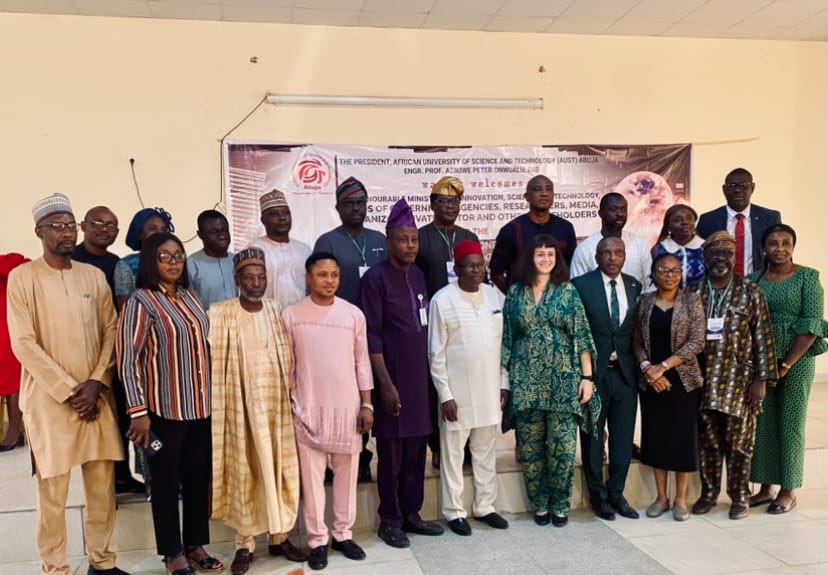
The three-day conference, held from January 20 to 22, 2026, at the Raw Materials Research and Development Council (RMRDC) Conference Hall, AUST, brought together scholars, policymakers, scientists, communicators, industry leaders and development practitioners from across the country.
Declaring the conference open, the President of AUST, Prof. Peter Azikiwe Onwualu, stressed that effective science communication is no longer optional for developing nations but a critical tool for addressing challenges in public health, education, food security, climate change, digital transformation, governance, security and economic growth.
According to Prof. Onwualu, while scientific discoveries and technological innovations are rapidly transforming global economies, their true value lies in how well they are communicated, understood and applied for societal benefit.
“Without clear, inclusive and responsible communication, even the most impactful research risks remaining disconnected from public policy, industry application and societal impact,” he said.
Speaking on the conference theme, “Communicating Science, Technology and Innovation for National Development,” Prof. Onwualu described communication as the bridge between knowledge creation and societal transformation. He noted that effective science communication empowers citizens, informs evidence-based policymaking, strengthens public trust in science and ensures innovation delivers measurable national
SITCOMS 2026 provided a multidisciplinary platform aligned with the triple helix model of innovation, bringing together academia, industry and government to strengthen collaboration and “gown-to-town” engagement. Participants explored strategies for translating research outputs into accessible knowledge that can improve livelihoods, influence policy and drive commercialization.
Reaffirming AUST’s commitment to socially responsive scholarship, Prof. Onwualu emphasized that universities must go beyond knowledge generation to ensure research outputs are accessible, impactful and aligned with societal needs.
He highlighted the role of AUSTInspire, the university’s innovation hub, in promoting research commercialization, entrepreneurship, skills development, technology incubation, continuing professional development and Technical and Vocational Education and Training (TVET). He disclosed that AUST has registered 12 patents in the last two years and is actively engaging government and industry partners for their commercialization.
“We invite investors, entrepreneurs and partners to work with us in co-developing and commercializing innovative solutions to the numerous challenges confronting Nigeria and Africa,” he said.
Delivering the keynote address, Prof. Hilary Inyang, NNOM, Founder and Chair of the Global Institution for Sustainable Development, Advanced Analysis and Design, emphasized the need for scientists to actively engage policymakers and the public.
Prof. Inyang said scientific knowledge must be translated into language that decision-makers and citizens can understand, noting that national progress depends on how effectively evidence informs policy and governance. He called for stronger collaboration among researchers, communicators and government institutions.
Also speaking, the Director-General of the Sheda Science and Technology Complex (SHESTCO), Dr. Abayomi Theophilus Oborishade, highlighted the role of innovation institutions in bridging the gap between research and industry.
Dr. Oborishade noted that while Nigeria has a wealth of research outputs, weak communication and commercialization frameworks continue to limit their impact on industrial growth and job creation. He advocated stronger partnerships among universities, research institutes and the private sector.
In a special town hall session on national honours and scientific contributions, Prof. Inyang, in his capacity as Chairman of the Nigerian National Order of Merit (NNOM), led discussions on the recognition of excellence in science and innovation, stressing that honouring outstanding scientists inspires younger generations and strengthens public confidence in science.
At the conclusion of the conference, participants adopted a communiqué calling for , Stronger national frameworks for science, technology and innovation communication,Capacity building for scientists, journalists and communicators Increased media engagement with scientific institutions, Improved collaboration among academia, industry and policymakers.
Participants agreed that science communication must be mainstreamed into development planning and policy implementation if Nigeria is to fully harness the benefits of research and innovation.
Speaking during the closing session, the Chairman of STICOMMS 2026, Dr. Bosco Okolo-Obi, expressed appreciation to participants, speakers, partners and the Local Organising Committee for their contributions to the success of the maiden conference.
Dr. Okolo-Obi thanked all stakeholders for their commitment and collaboration, noting that their collective input was instrumental to the successful hosting of the conference and the adoption of actionable outcomes.
In his closing remarks, Prof. Onwualu also thanked participants and partners, describing STICOMMS 2026 as a platform for strengthening collaboration between academia and industry.
“This is about collaboration. Let us work together to make things happen. Thank you all for visiting AUST,” he said.
2026 concluded with a commitment to sustain dialogue, partnerships and policy engagement, positioning the conference as a foundation for future national efforts in science communication and innovation-driven development.