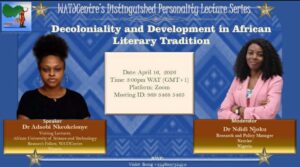
The West African Traditional Justice Centre hosted an online Distinguished Personality Lecture on Thursday, 16 April 2026, focusing on Decoloniality and Development in African Literary Tradition.
The lecture explored how African literary traditions can offer alternative frameworks for understanding development beyond conventional technical and economic indicators. The session brought together scholars and practitioners to examine the intersection of literature, knowledge production and development practice.
In his opening remarks, the host, Dr Philip Olayoku, introduced the Centre as a platform dedicated to bridging the gap between research and practice in transnational justice across West Africa. He noted that the initiative seeks to foster meaningful dialogue and encourage practical interventions in the field.
Moderating the session, Dr Ndidi Njoku outlined the thematic focus on decolonisation, African-centred development models and knowledge production. She emphasised the importance of using literature to generate diverse narratives and evidence that challenge dominant development paradigms.
Delivering the keynote presentation, Dr Adaobi Nkeokelonye, a Visiting Lecturer at AUST, examined how literature can function as a tool for decolonising development. Drawing on people-centred development theories, including those of Amartya Sen, she argued that prevailing global development frameworks often reflect Western constructs that undermine local agency and reinforce dependency.
Dr Nkeokelonye highlighted the implications of external interventions, referencing recent shifts in United States aid policies and their impact on health systems in Nigeria. She defined decoloniality as the process of reclaiming indigenous knowledge systems, narratives and social structures, advocating for development approaches rooted in local contexts, dignity and lived experiences.
The interactive session, attended by 28 participants, featured robust discussions on key issues, including the credibility of fiction as a source for development implementation, the impact of censorship on literary expression, and methodological approaches for integrating fictional and oral literature into development research.
Contributing to the discussion, Dr Chuma Nwokolo identified self-censorship as a significant barrier to authentic storytelling. He noted that societal and familial pressures often shape literary output, limiting its potential as a tool for social transformation and development.
In her closing remarks, Dr Nkeokelonye underscored the importance of rethinking development paradigms, stating that “decolonising development involves unlearning and reimagining, with literature as a fundamental tool for that process.”
Dr Olayoku, in his concluding remarks, called attention to the marginalisation of the humanities in contemporary development discourse. He advocated for the creation of interdisciplinary fields such as fiction-and-development, supported by dedicated methodologies and academic curricula. He further emphasised the need for sustainable, locally driven approaches over donor-dependent models, while encouraging the integration of oral traditions into modern research practices through the use of technology.
The lecture forms part of ongoing efforts to promote critical discourse on development and strengthen African-centred approaches to knowledge production.