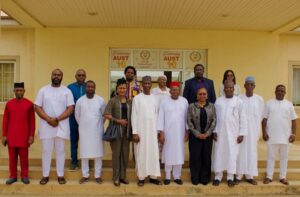
The African University of Science and Technology (AUST), Abuja, recently received a five-member verification team from the National Universities Commission (NUC) as part of activities preceding the accreditation of more of the University’s academic programmes.
The visit brought together NUC reviewers, members of AUST’s leadership, and representatives from both academic and administrative units.
The engagement provided an opportunity to formally welcome the accreditation team, outline the University’s strategic direction, and reaffirm its commitment to maintaining high academic standards.
In his remarks, Prof, Azikiwe Peter Onwualu, FAS, highlighted AUST’s road map and its continued support from the World Bank and other development partners.
He emphasised the University’s evolution from a postgraduate-focused institution to one that now offers carefully phased undergraduate programmes, while maintaining a strong emphasis on research excellence and quality postgraduate supervision.
The President further noted that AUST’s academic framework is built on global best practices, supported by a network of visiting and diaspora faculty who contribute to teaching, research, and supervision. He stressed that the University’s rigorous standards, including publication requirements for doctoral candidates in internationally recognised journals, are designed to ensure competitiveness and global relevance.
Dr Vitalis Anye delivered a presentation on the University’s Centres of Excellence and its recently established Centre for Artificial Intelligence and Emerging Technologies, which aim to bridge the gap between research, industry, and policy.
He also outlined AUST’s extensive partnerships with international organisations, including World Bank initiatives, the African Development Bank, and Erasmus+ collaborations.
He further showcased the University’s state-of-the-art laboratory facilities, ongoing research projects, and innovation-driven initiatives, including its 3D printing hub and professional development programmes.
These efforts, according to the University’s leadership, reflect AUST’s commitment to addressing real-world challenges and contributing to national and regional development.
The presentation also highlighted the institution’s network of 11 Centres of Excellence, including those focused on materials science, climate change adaptation, mineral exploration, transport systems, gender and trade policy, and the newly established Centre for Artificial Intelligence and Emerging Technologies. These centres are designed to strengthen applied research, industry collaboration, and policy engagement.
He further outlined its extensive portfolio of externally funded projects and partnerships, including support from the World Bank Africa Centres of Excellence programme, the African Development Bank, PASET initiatives, Erasmus+ exchanges, and other international research collaborations, including NASA-related linkages. These partnerships, it was noted, have significantly strengthened research capacity, staff exchange, and innovation-driven development.
Infrastructure and laboratory facilities funded through development grants were also highlighted, with emphasis on advanced equipment supporting research in materials science, physics, petroleum engineering, and biomaterials. The institution reiterated its commitment to translating research outputs into practical solutions, citing examples such as 3D-printed personal protective equipment produced during the COVID-19 pandemic.
The review session further underscored AUST’s Innovation Hub, which supports entrepreneurship, commercialisation of research, and student participation in international innovation challenges. Additional initiatives include capacity-building programmes, gender inclusion in STEM, and over 30 continuous professional development courses in emerging fields such as data science and project management.
The NUC delegation representative Prof. Mohammad, commended the University’s efforts in expanding its academic portfolio and strengthening its research ecosystem. Discussions also highlighted AUST’s four schools, growing undergraduate offerings, and a wide range of postgraduate programmes spanning science, engineering, computing, and policy-related disciplines.
The courtesy visit concluded with mutual assurances of collaboration and a shared commitment to ensuring that AUST’s programmes meet and exceed national accreditation standards. The accreditation exercise is expected to further strengthen the University’s position as a leading centre for science, technology, and innovation in Africa.
Present at the meeting were, Professor Azikiwe Peter Onwualu, FAS, (President, AUST); Dr Abdulhakeem Bello (DAP/ Acting Vice President, Academic); Mr Ben Okonkwo (Bursar); Mr Inegbenose Osoba (Ag. Registrar); Mrs Onyebuchi Ekpolomo (University Librarian); Dr Vitalis Anye (Dean, School of Engineering/Head, Department of Materials Science and Engineering); Dr Abubakar Haruna Mohammed (Dean, School of Management Sciences); and Professor Mrs Munirat Yusuf-Habeeb (Head, Department of Business Administration), while the visiting NUC delegation includes, Professor Mohammad Madawaki (Public Policy and Leadership department, University of Maiduguri); Professor Umar Adamu, Gombe State University; Mr Desmond Orion, Ms Pamela Azubuike and Mr. Moses Ehibor from the NUC office.